Lagunita drainage due to trout Calif. tiger salamander myth unfounded
By Lizzie Eason
Co-Lifestyle Editor
Since before Stanford’s founding in 1891, the southwest corner of the main campus has been home to a seasonal reservoir known as Lake Lagunita, which used to fill to its brim with water in fall and winter and then gradually disappear by the end of summer before starting its lifecycle over again.
When Lagunita was full, Stanford students would swim and canoe in its waters and local farmers would tap into it to irrigate their fields. This was the way it had been for over a century since its creation to provide irrigation for the fields of the Palo Alto Stock Farm. But all of that changed 15 years ago when the lake became noticeably shallower during the winter.
This change was caused supposedly by a species of California tiger salamander that was discovered living in the lake and the surrounding hills. According to popular belief, the discovery of this species led to the lake holding less water during the winter to accommodate their breeding habits.
This is not the case.
According to Carol Boggs, a biology professor at Stanford University, the species of salamander has been known to use the lake for breeding for years. The real culprit is the endangered population of steelhead trout living in the San Francisquito Creek nearby.
Lake Lagunita used to be filled by irrigating water from this creek to the lake. Today, Stanford can no longer use that water because the trout need it.
Alan Launer, facilities engineer and coordinator for Land Use and Environmental Planning at Stanford University, says he has “no idea” how the misconception occurred.
“It doesn’t make any sense. I guess that story just got passed down from student to student and no one ever questioned it,” he said.
Today, the lake is around 10 feet more shallow than it was 15 years ago, but the populations of salamander and trout are listed as threatened instead of endangered. This is an improvement according to the International Union for Conservation of Nature.
The
lake now uses water from nearby Felt Reservoir and

Photo courtesy of the Stanford Website
EVEN WHEN LAKE LAGUNITA is drained, it still can be used for recreation. Runners and walkers can often be found on the trail circling the the lake.
The Earth Science Class has taken multiple field trips to enhance the classroom experience.
Herons Head & Alviso: visited an “off-the grid” building and helped cull invasive species
Jasper Ridge Biological Preserve
Hoover Tower
WWTP: a waste-water treatment plant Lagunita
“The field trips help so it’s not just ‘water cycle, water cycle, water cycle` over and over in
class,” Emily Barnes said. They have also had many guest speakers come to class. Raynelle Rino (Ecologist, Herons' Head Park): spoke on environmental justice
Dr. David Freyberg (Professor, Stanford University): spoke at Jasper Ridge
Dr. Jan Walbrecker (Postdoc, Stanford University)
Greg Smith (Technician, Palo Alto Regional Water Quality Control Plant)
|
On a field trip to San Francisco last Saturday, EPGY students felt the fury of an earthquake, grazed the bumpy skin of starfish in tide pools, and marveled at colorful butterflies that flew about their heads.
This was all at the California Academy of Sciences, a museum that houses exhibits such as the Morrison Planetarium, Steinhart Aquarium, Kimball Natural History Museum, and a four-story rainforest dome.
The academy was created as an institution dedicated to researching and teaching about the natural world. It was completely renovated and re-opened in 2008 with many new exhibits.
At first, students did not know what to expect from the academy.
“I heard about the academy from my friends, and they said that it was supposed to be really interactive,” said Yoh-Yoh Wang, a 15-year-old anthropology student from Singapore. “But I wasn’t sure because it’s a museum and museums are supposed to be boring. So I was sort of preparing for the worst, but expecting the best.”
Wang, along with many other students, ended up greatly enjoying the experience.
One of Wang’s favorite exhibits was the Steinhart Aquarium, located below the rainforest dome.
“They had a lot of different sections,” she said.
Indeed, the aquarium alone contains 38,000 animals and over 900 species, from piranhas to moon jellyfish to penguins in the African Hall. Students could walk into one area of the aquarium and watch fish and turtles swim around and overhead beyond the glass. This is the “flooded forest,” an extension of the rainforest dome.
Screenwriting student Will Parmacek appreciated the diversity of topics in the museum, in particular the rainforest and aquarium exhibit.
“I always loved the ocean and water but I also love rainforests so it really felt like a cool learning expedition,” he said.
“We went to the planetarium and they had a show about earthquakes,” Wang said. “I felt that, even though I learned a lot,
EPGY Rules: -Campers must sleep in their assigned room/bed, and if he/she has guests in his/her room he/she must have his/her door open wide enough for counselors to see inside.
-House meeting is at 10pm Sun-Thurs and 11pm is lights out (1 hour later on Friday and Saturday).
-Drug, alcohol, and tobacco use is strictly prohibited.
-If a camper is leaving the residence s/he must use the sign out sheet and get the signature of a counselor. Upon returning the camper must sign back in.
-Special arrangements must be made for off-campus visitors and campers can only be picked up by
people on the approved visitors list.
-Visitors can’t come into the residences on campus.
-Campers can’t visit residences of other programs.
-One half hour of personal computer time is allotted per day.
|
LEE AXELROD, HEAD TREAT COUNSELOR |
|
Courtesy of the Stanford Website
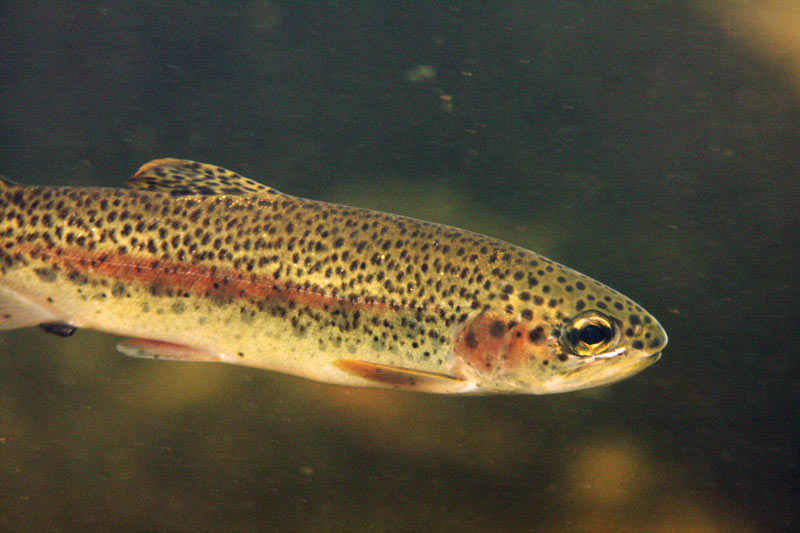
A STEELHEAD TROUT swims in Los Trancos Creek in July 2009. The creek's population of trout need the water from the lake to survive -- the Calif. tiger salamander is not to blame.
Courtesy of the Stanford Website
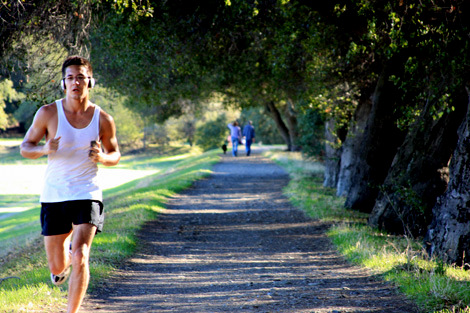
EVEN WHEN LAKE LAGUNITA is drained, it still can be used for recreation. Runners and walkers can often be found on the trail circling the the lake.
wells when that water
isn’t enough. Unless the amount of water in San Francisquito Creek
increases dramatically, Lake Lagunita will continue to be filled to the
bottom of its dam instead of to the top.
Stanford is also working on posting more informational signs about why
the lake is no longer filled to its original level so that the students
will know the truth about Lake Lagunita.
Earth Science field trip reveals a two-sided dam debate
By Emily Beltran and Jane Gardner
Co-Opinion Editor and co-Lifestyle Editor
In the picturesque foothills of the Santa Cruz Mountains, the century-old Searsville Dam is at the center of an ecological debate raging over whether or not to remove it.
The Searsville Dam was originally built to provide San Francisco with drinking water in 1892. When it was discovered the water was undrinkable, the lake became a research center for Stanford University while also remaining open to the public for recreational use.
In the 1970s, Stanford closed the lake to the public, and the dam became part of the Jasper Ridge Biological Preserve.
The EPGY environmental science class took a field trip to the preserve last week to experience water conservation and the present struggles of the dam first hand.
This field trip was a highlight for the class.
When asked why students enjoyed this one more, Emily Barnes, a 17-year-old student from Colorado, replied, “I think there were a lot more applications for people’s interests. And also the problems at the dam are a lot more pressing so it’s easier to connect to it.”
The pressing issues she mentioned are the source of the debate. The dam has stopped salmon and other native fish from migrating up the river. The lake, which is now 90 percent sediment, has also flooded areas up stream.
“We saw two different arguments,” said Tita Kanjanapas, a 15-year-old from Thailand. “One, for the dam, was given by a professor there.” The professor said the dam was beneficial because its water is used for irrigation both on and off the Stanford campus.
The dam is also home to many species of fish, birds, and bats whose homes would be destroyed if the dam was removed.
On the other hand, they also read an article with a negative view of the dam because of the native fish migration issues.
The two girls agreed it was interesting to see both sides of the dam’s story – and the dam provided an opportunity education outside the classroom.
The students saw how people collected data in the field, unlike when they were in the classroom and collected data only through their computers.
“It definitely gave me a better appreciation for how rough these measurements actually are,” Emily Barnes said. “These measurements, which we’re taking as a rule, or as a fact, are really very imprecise.”
According to student Fathi Assegaf, a 14-year-old from Indonesia, seeing the preserve was also very inspiring.
“I think it showed that even though humans can drastically change natural cycles, nature still triumphs over everything,” Assegaf said.
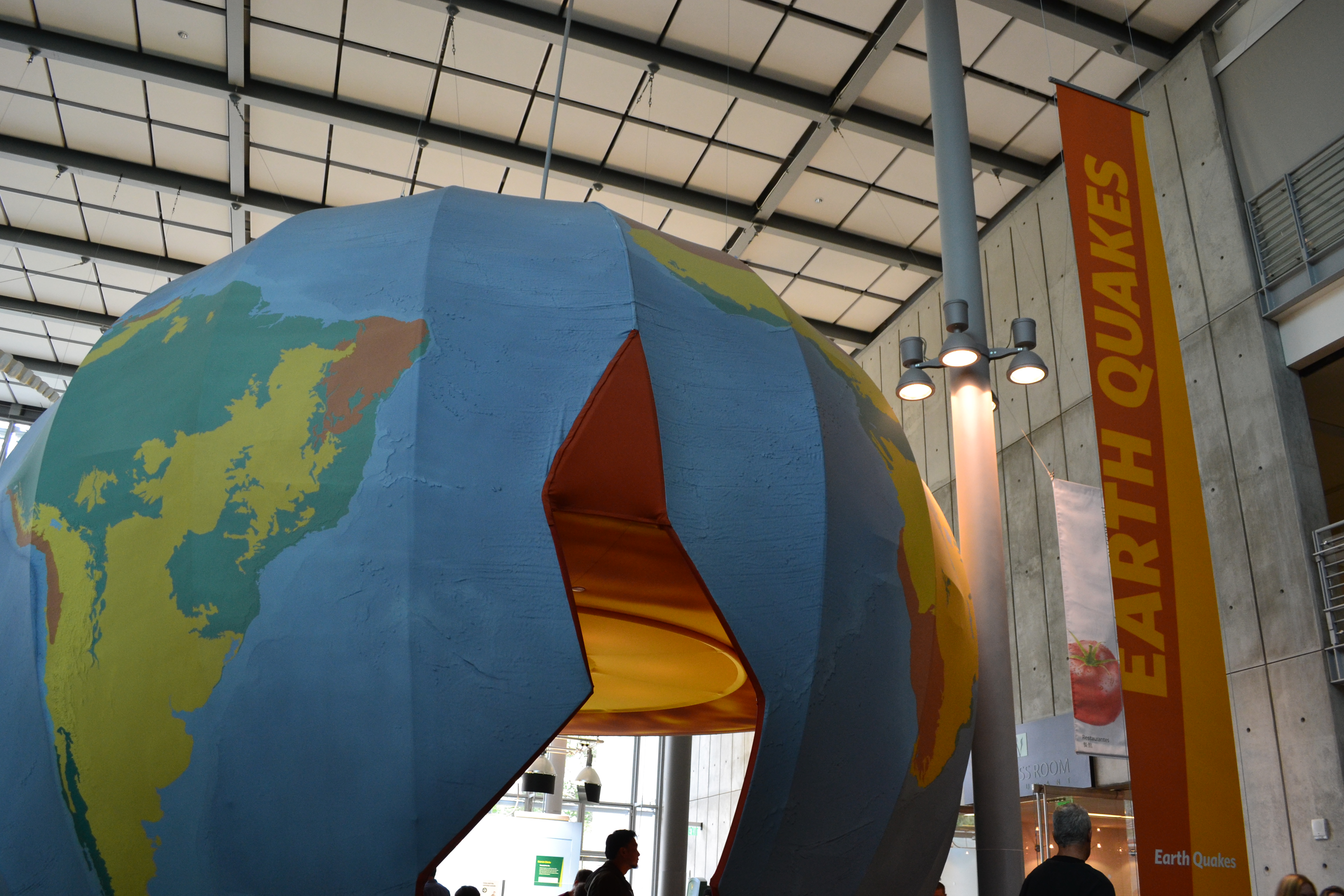
THE CALIFORNIA ACADEMY of Sciences's new earthquake exhibit.
it wasn’t as if I was sitting in a classroom or just reading. It was really fun.”
Along with the show, the museum has an exhibit where visitors can
experience the two largest earthquakes in San Francisco history.
Along with a new look and new exhibits, the museum now has more environmentally friendly measures.
“All the water fountains encouraged you to drink tap water instead of bottled water, and the food court had all this organic and natural food,” Parmacek said. “They just tried to do everything to protect the environment.”
In fact, the academy is now the world’s greenest museum, according to
the Leadership in Energy and Environmental Design program. It boasts
solar powered electricity, natural lighting, walls insulated with
recycled blue jeans, and a 2.5 acre living roof, which is a roof covered
with vegetation and benefits the environment as well as saves money.
Some students said that one problem with the visit to the museum was that it was so big it was hard to see it all.
“There were just a lot of exhibits and I don’t think that we were able to enjoy them well,” she said.
For Parmacek, who had never been to San Francisco, more touring of the city would have improved the trip.
“Mainly I just wanted to see the [Golden Gate] bridge,” he said. “But the museum was cool.”
Students evaluate EPGY rules
By Lizzie Eason
Co-Lifestyle Editor
It’s 30 minutes before lights out at the Education Program for Gifted Youth 2010. First-year counselor Russ Nickel is sitting in his dorm room minding his own business when suddenly the head counselor bursts into his room unannounced.
“Russ, come smell toothbrushes with me!” she cries.
This is an odd request, and Russ asks why she would want him to smell toothbrushes. She replies she has gotten a tip from another camper that a girl and a boy have been smoking in the bathrooms, an activity forbidden at EPGY.
Russ reluctantly leaves his room and enters the boy’s bathroom to find a toothbrush reeking of cigarette smoke. He reports back to the head counselor and the two campers are immediately sent home.
Clearly rules are often broken at summer camps -- and EPGY takes its rules about tobacco, drugs and alcohol particularly seriously, since those rules also involve California state law. But how serious and frequent are the lesser infractions at EPGY this year?
In a survey of students at the Treat residence, nearly all the campers said they have used study time to do personal things other than homework -- technically a violation of the rules -- and roughly half said they went over their allotted half hour of personal computer time. Far fewer numbers admit to having guests in their room with the door closed or leaving the residence without signing out.
Why are there so many infractions? Many campers say it’s because the rules need to be changed or are hard to follow in certain circumstances.
“The rules have 100 percent enforcement. Sometimes we need some slack,” said Reed Motulsky, a camper staying in the Murray residence from New York City.
Emily Beltran, a 17-year-old camper from Chicago from the Treat residence would agree, especially in the case of the study time rule.
“Everybody has different work strategies,” said Beltran. “We’re all good students, but we all have our own study habits. I think the counselors need to realize we all know ourselves well enough that we will get the homework done in our own ways. I. . .can’t focus for three hours straight and need to have short breaks in between.”
Beltran and Motulsky are not the only campers who think some rules need to be changed. Sam Hao, a camper from the Murray residence, thinks students could get a more realistic experience of student life if they were allowed to visit residences of other programs.
She adds the EPGY summer camp experience should help campers gain an idea of life at Stanford, and limiting the campers to their individual clusters narrows their picture of the University.
One of the most controversial rules is the half hour of personal computer time allotted per day.
While counselors maintain this rule is in place to keep campers from being antisocial and encourage friendships to be made, first-time EPGY student Nancy Coleman claims more personal computer time is needed to keep up with the world outside of camp.
“We’re not going to stop socializing because we have access to computers,” she said. “When you’re at a camp like this, it’s hard to keep up with the rest of the world, and it’s important to keep up with what’s going on at home.”
Lee Axelrod, head counselor of the Treat residence, would disagree.
“All the rules have their purpose,” Axelrod says. “Most of the rules are fair and aimed at creating a safe, structured environment.”
Russ Nickel, who has now been with EPGY for three years, said rule following is improving within the program.
“Every year I’ve worked here it seems the students get progressively better. The counselors all know what they’re doing. We haven’t had many major infractions, and those we do have are dealt with quickly and efficiently.”
|