Stanford's Alvarez spreads smiles at EPGY
By Emily Beltran
Co-Opinion Editor
As high-spirited Luis Alvarez began his freshman year at Stanford, he did not realize where his journey at Stanford would take him, including becoming an EPGY counselor.
Alvarez, originally set on pursing a law career, dabbled in many classes and activities in his early college days that eventually led him to volunteer at Arbor Free Clinic.
Every Sunday during his spring quarter freshman year, Alvarez, who grew up in a traditional Hispanic household and learned Spanish as his first language, would venture to the clinic in Menlo Park and serve as an interpreter for the Spanish speaking patients with no health insurance.
Throughout the weeks of working closely with the patients, Alvarez realized that law was not for him.
“I really loved the patients at the clinic,” Alvarez said. “Interpreting really made realize what I want to do.”
Alvarez, a rising junior, now wants to pursue a career as a pediatric oncologist because of his interest in medicine and working with people, especially children.
When a friend presented Alvarez with the opportunity to apply for a counselor position at EPGY, he was immediately intrigued by the opportunity to work with young people all summer.
This is Alvarez’s first summer with the program. He was a TA for 20th Century Science and Technology last session and is helping with 20th Century Humanities currently.
“I am so proud of my class for reading William Faulkner’s `Absalom, Absalom!` They are working so hard and really getting into it,” he said.
Alvarez’s favorite experience during EPGY was the first session dance. “All the kids were so happy, and the counselors had an awesome dance party in the middle,” he said.
He also thought counselor Russ Nickel’s puns were very funny during the talent show and remembers how all the students were crying at the end of the session because of all the good friends they had made.
EPGY has also been an opportunity for 19-year-old Alvarez to learn and be challenged. While it has been hard for him to get kids to listen to him because he is only a few years older than his campers, he has learned a lot about why high school students act the way they do.
“It gives a different perspective and made me realize that this [working with kids] is something I really want to do with my life,” said Alvarez.
If Alvarez could give advice to the campers, he would suggest really embracing every opportunity at EPGY.
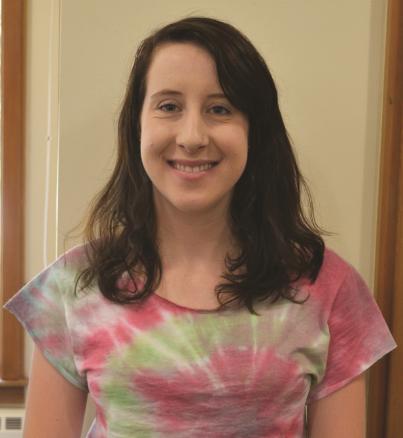
LEE AXELROD, 22, stops for a photo during study session July 25. Axelrod is Treat's head counselor and a teacher's assistance for the 20th Century Humanities course.
Lee Axelrod
Parents: Robert and Christy Axelrod
Brother: Charles Axelrod
Favorite Movie: Ten Things I Hate About You
Favorite Food: Chocolate and Cheerios (not at the same time!) Favorite Author: Jane Austen (favorite book is Pride and Prejudice) Favorite Artist: Edgar Degas
|
Lynch transfers history and RA skills to EPGY's journalism class
By Emily Beltran
Co-Opinion Editor
As a history major, Laura Lynch learned many thinking and writing skills such as synthesizing information and making a good argument.
These are necessary skills for journalism, the class Lynch is TAing this summer in the EPGY program.
“The EPGY summer program is one that all Stanford students know about and want to apply for,” Lynch said. “I thought that I’d give it a shot.”
Lynch, who just graduated this past June, originally helped with the Summer Humanities Institute and then moved to EPGY.
“I loved my time at Stanford,” Lynch said. “I want to stick around as long as I can.”
Lynch’s favorite memory during EPGY was the last night of session one when all the kids were crying because they were so sad that they has to leave. She loved how close they became and how much they had enjoyed their summer.
Lynch has learned so much from the wide variety of students at EPGY.
“I have learned so many fun facts. Did you know that there is an international language for musicians?” said Lynch. “So you can sing in a foreign language and still sound right.”
The most challenging part of EPGY for Lynch has been balancing her time between searching for a job after the summer and fulfilling her counselor duties, which she does well, always happy and smiling.
With her history degree, Lynch plans on breaking into the non-profit sector with a job in business operation. She wants to go to grad school and work in health promotion behavior, especially behavioral intervention with disease in the developing world, some day.
During her time at Stanford, Lynch helped with a program called FACE AIDS, which helped develop her passion for international development.
FACE AIDS helps fight AIDS in Rwanda with help from a program called Partners in Health.
“I love studying infectious disease development,” Lynch said. “I love world news.”
Lynch’s interest in world news has helped her TA journalism at EPGY.
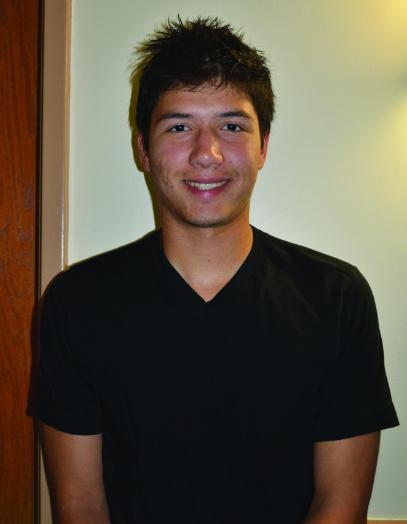
ALEX ROSAY, 19, poses for a photo during study session on July 25. After serving as his dorm's intramural coordinator, it was a natural transition for Rosay to become the GovCo Cluster's activities coordinator.
WILL PARMACEK, 16, smiles for a photo outside the computer cluster in Treat July 29. Parmacek is a screenwriting student visiting EPGY from Philidelphia.
Skinner aims to study worldwide
By Paulina Graham
Co-Opinion Editor
Russel Skinner, 17, was sitting at the California Academy of
Sciences aquarium gazing at the fish boxed in a glass cage. “There is something
so surreal about aquariums… but they’re depressing,” he said. “Maybe in
Atlantis it’s backwards. Imagine mermaids and fish having humans trapped in
glass boxes.” The next day Skinner was hunched over his worn out journal
sketching his idea.
Skinner, an Anthropology EPGY student, believes that his
inclination to art may come from his family. His mom was a dancer and his
father, an aspiring sculptor, moved to New York City at 18 to attend art school
at Pratt located in Clinton Hill, Brooklyn. His older brother went to art high school, and
is now attending Pratt as well.
“My parents have always told me to try to express myself
artistically,” he said. “I think it’s always been part of my life.”
Even though Skinner attends “a very academic school” he
still finds time to immerse himself in his passion for art. “When I have free
time, instead of wasting my time on electronics, I’ve been trying to draw, or
write something, or make music with my brother,” he said.
Growing up in New York has also been a major contributing
factor to Skinner’s interests. “Your surroundings and your environment
influence how you turn out. I think that growing up in New York City and being
exposed to art culture… And my brother getting into graffiti and hip-hop, and
passing that on to me… It all has an effect.”
Skinner believes that art will always be part of his life.
However, academically, he has been leaning towards Anthropology and Archaeology. “I’ve always been interested in ancient cultures, mythology, and
ruins. Since I was a little kid, I
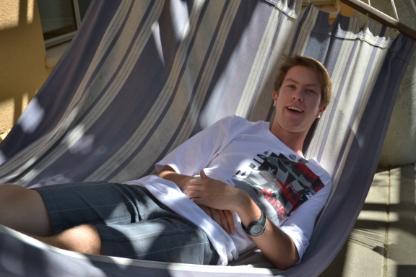
GRIFFIN FERRE, 17, takes a break from a journalism study session, enjoying one of Treat's back porch hammocks.
EPGY has outgrown creator's expectations
By Nancy Coleman
Assignments Editor
The prospect of studying for three weeks at Stanford brought 1300 students to Palo Alto from diverse
locations, ranging from London to Singapore.
Of these students, 300 are here abroad, representing over 40 countries.
With a number of students hailing from faraway places, EPGY is offering not only the courses being
taught, but a chance to familiarize with different cultures and customs.
“I think it gives me a different perspective as to how people from different places see the rest of the world,” said Bryn Brunnstrom , 15, a screenwriting student from London.
A multicultural experience such as the one being offered at EPGY also promotes awareness of differences, ranging from culture to basic infrastructure.
“I think the biggest difference is the streets are so clean. And everything is a lot nicer and more modern,” said Nicaraguan journalism student Paulina Graham, 15.
“People perceive the differences between the U.S. and other countries as greater because they are unfamiliar with the
EPGY has outgrown creator's expectations
By Nancy Coleman
Assignments Editor
When Rick Sommer helped create the
EPGY Summer Institutes in 2001, there were only two courses and 43
participants. He had no idea that the program would grow to 41 course options
and over 1,300 students.
“The EPGY Summer Institutes is my
biggest accomplishment,” Sommer said. “When we started it, nobody predicted we
would be where we are today with it. The number of courses, the number of
applicants and the overall quality of the program make it pretty substantial.”
And the program’s still growing.
This summer, EPGY – the Educational Program for Gifted Youth – helped develop
the Stanford Summer Humanities Institute in collaboration with faculty from the
university’s School of Sumanities and Sciences.
Next summer, EPGY will work with the
music department to develop a summer high school orchestra program.
“There are a number of changes going
on in the pre-collegiate programs at Stanford,” he said. “EPGY
has transformed into a new unit at Stanford, the Stanford Pre-Collegiate
Studies, and I have a director role in that. We will be working with schools
and departments at Stanford and developing new programs that have similarities
to EPGY.”
Sommer drew on his own experience
when becoming involved in EPGY.
He recalls that when he was growing up in Sacramento, he always enjoyed math in
school, but he never knew what he could do with his talent. He was not aware
that a major in math was even a choice until college.
“I had very little knowledge of what
the academic options were, and one of the things EPGY does is provide
opportunities
|
|
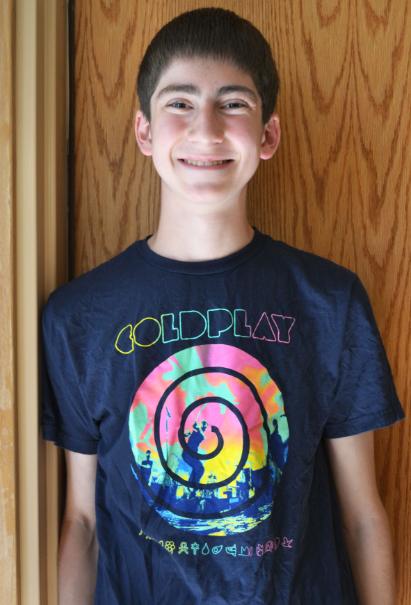
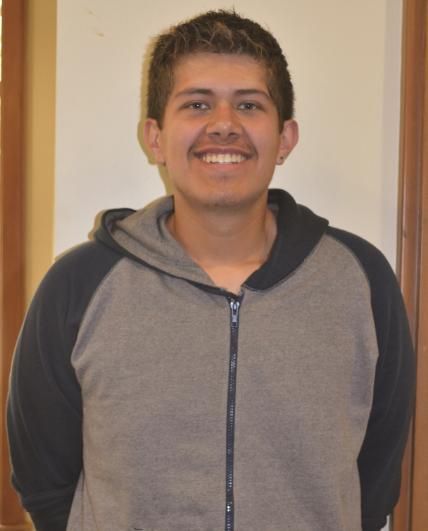
LUIS ALVAREZ, 19, poses for a photo during EPGY's afternoon study session July 25. Alvarez is a Teacher's Assistant for the 20th Century Humanities course.
Luis Alvarez
Home: South San Francisco, where he lives with his parents, brother, and grandmother
Parents: Mom - Carlota from El Salvador, Dad - Alvaro from Mexico
Hobbies/Interests: Football, soccer, the 49ers, board games, Settlers of Catan, going to concerts
Major: History
One word description: Optimistic
|
Besides
working with people, Alvarez also loves puppies. He frequently changes
all the Treat computers’ screen savers to pictures of young dogs.
“I love puppies!” Alvarez said. “I want two – a Bernese Mountain Dog and a German Shepherd.”
Alvarez himself is much like a puppy in many ways- always smiling and energetic.
“EPGY rocks,” said Alvarez, “And I’m really happy that I ended up working here.”
Counselor returns for third year at EPGY
By Jae Choi
Co-Photo Editor
“I declare after all there is no enjoyment like reading!” Jane Austen once wrote.
Lee Axelrod, head counselor for EPGY’s Treat residence wholly agrees with Austen.
Axelrod, 22, has been a counselor in the EPGY program for two summers. It was because of her past experience that she was chosen to be head counselor. “I love it because it is fun and enthusiastic and I love sharing my passion for literature with younger people,” she said.
But literature isn’t the only subject she’s passionate about.Since she was a child, Axelrod has been drawing and painting, leading her to a double major in English and studio art.
At EPGY, she is a teacher’s assistant for the 20th century art, culture and aesthetics class -- a position she held last year as well.
“It’s nice to know all the material and the instructor is great and fun to work with,” she said.
In the class, students explore the way fiction and film during the last century depicted some of the major changes that were occurring in culture and technology.
For example, the class has read “Absalom, Absalom” by William Faulkner and “The Metamorphosis,” by Franz Kafka. Students then wrote essays on thematic and formal analyses and participated in discussions of the text.
Axelrod’s role during these discussions is to facilitate the students by, “ask probing questions to get the students thinking in a different perspective.”
This fall, Axelrod will enter Stanford’s graduate program to work towards her masters in literature.
“I always liked reading and was very talented in analyzing it,” she said. “I was sure I wanted to be in that field ever since I graduated from high school.”
When she’s not reading and analyzing literature or drawing and painting, Axelrod can be found running, snowboarding or taking photos.
Axelrod is forever grateful to EPGY for helping her, “get to know fun people,” and spend time with her class discussing literature. “Connecting with the students is the best part of camp,” Axelrod said. “Watching them leave on the last day is difficult and sometimes emotional.”
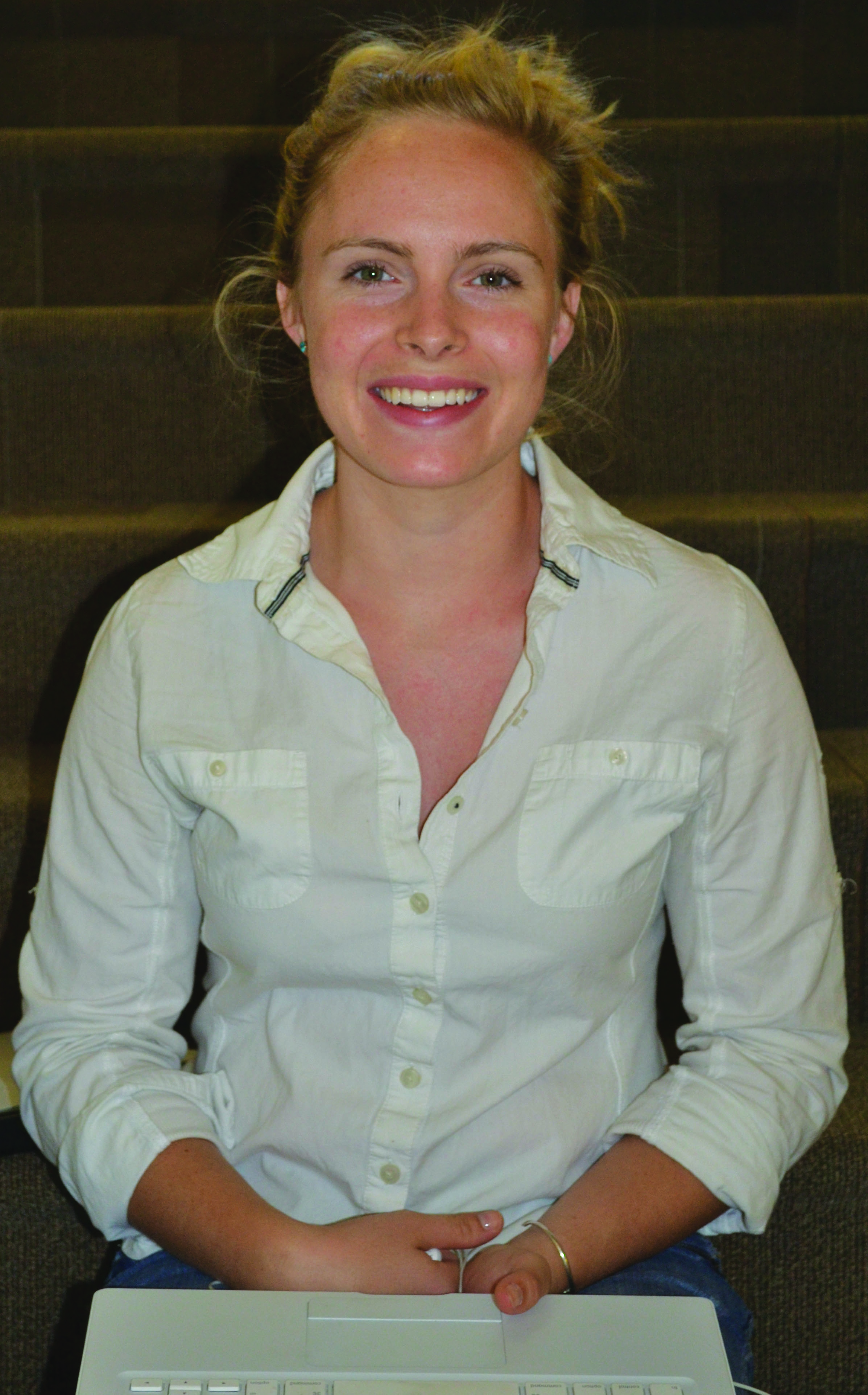
LAURA LYNCH, 22, takes a break from revising student papers on July 25. She is a TA for EPGY's journalism course.
Laura Lynch:
Hometown: Rome, Georgia
Favorite Movie: “Roman Holiday”Hobbies: running and exercising
Favorite Food: Indian
One word description: smiley
Family: Parents - Joan and Martin
Siblings - Kat (23) and Jack (19)
Activities at Stanford: RA senior year, rowing team, sorority
|
Rosay doubles as activities counselor and friend to students
By Daniel Bang
Co-Sports Editor
Even as a kid growing up in Los Angeles, Alex Rosay always loved going outside, playing sports, being
active and being social with the other kids his age, so when he saw the
fliers going around his Stanford dormitory about a summer camp for
teens, applying to be the activities counselor was a no-brainer.
Rosay, 19, was already the intramural coordinator for his dorm, so planning different ways for high school students to interact wasn’t anything new for him.
When asked what he liked most about the job, he replied “the people definitely. The people make this job really fun and getting to know people in general makes being activities counselor fun.”
But being activities counselor isn’t all fun and games.
Rosay has to trek around campus to find ideal locations for different student activities. He also juggles the schedules of a variety of different events like soccer,
badminton, bracelet-making and even a train trip to the neighboring
Redwood City for a film screening of “Dark Knight Rises.”
When asked what the most difficult part about being the coordinator is, Rosay said it was not being able to give everyone their first choice, and having to tell them “better luck next time.”
“Alex puts in a lot of work and always tries to give us our first choices. At the same time he’s really social and fun to be around,” said sophomore Elizabeth Gillingham.
All in all, Rosay loves the experience of being able to allow high school students to have a fun time.
Since he’s only two years out of high school, getting to know the
campers isn’t just a counselor-student relationship, but a friend –to
–friend relationship as well.
Parmacek has high hopes for short film
By Kelly Butler
Advertising Manager
Though it does not yet have a name, Will Parmacek, a 16-year-old from Philadelphia, believes the 30-minute short he created for the EPGY screenwriting class could go on to be something more.
Featuring a terminally ill, elderly man named Scott, the story explores how our actions impact our entire lives – and the lives of others. Scott wakes one day to find himself in the middle of the Vietnam War – something that had happened long ago when he was 26.
Stuck in a paradox of his past, every time Scott sleeps, he wakes up in a day that had already happened, losing his son, wife, and best friend in the process.
“Our character had to have a main flaw,” Parmacek says, explaining why he gave the old man such a terrible life. “He overreacts to everything. He’s selfish.”
Despite this, Parmacek relates to Quinn on a certain level. He describes both himself and his character as innocent people who “don’t do anything too terrible.”
Parmacek hopes audiences will feel the same way. “I hope they’re able to connect with the main character and the struggle he’s going through,” he said.
Parmacek came to think of this unique short when he was lying in the grass during work hours. “I was just thinking and writing whatever came to my mind,” he says. “I thought of the character first. I just thought of a guy and then the rest happened.”
He also says his fellow students in screenwriting helped. “You put a lot of creative people together and magic happens,” he says with a smile.
was fascinated by the native Latin American
culture and art style.”
He explains that as an Anthropologist, he wants to study
these indigenous cultures in depth, and put the information on record so that
it is available to the public. “There are so many legends that you can look up
online, but every source gives you something different, and it’s never really
clear,” he said.
Traveling to places such as Jamaica, Rome, and Puerto Rico
has also added to Skinner’s fascination with foreign cultures.
However it was
his trips to Peru and Belize that ignited his interest in Anthropology.
“It made me think about things I could study, and ways I
could apply my love for history,” he explained.
In Peru, Skinner hiked the Andes Mountains for 4 days with a
tour guide, an Inca descendant. They spoke to Quechua women, and shared
legends.
“It was just very cool, being out in the wilderness seeing
mountains for as far as you can see, and you look up and see the Milky-Way, and
[the tour guide] tells you all these stories about it," he said.
Skinner’s tour guide in Belize, an anthropology major, made
him realize that tourism is a major outlet to pass on knowledge. “He also told
me that people are digging up their backyards and finding new artifacts every
day, so it’s not like there’s nothing else to discover still,” he said.
Despite his undeniable love for anthropology, travelling,
and exploration, Skinner admitted that he will always want to return to New
York City and that if he ever has kids, he would like to raise them there.
“I love New York City, and I always want to come back and
live there. There’s something about living in the city, and having freedom as
you grow up that is really awesome. But I think that the world is meant to be
travelled, it’s meant to be seen… I just want to see it,” Skinner said.
Ferre's love of sports reaches career goals
By Paulina Graham
Co-Opinion Editor
EPGY Journalism student, Griffin Ferre, 17, is not your
typical aspiring Sport Journalist; he has seen first-hand how the industry
works.
Through his father’s connections, Ferre had to opportunity
to visit ESPN Los Angeles studio where the TV show “Sports Center” is filmed.
He met up with Neil Everett, a “Sports Center” news-anchor who gave him a tour
of the studio, and showed him how the show is managed.
“I got to sit on the table where they sit during the show,
it was amazing,” he said.
Ferre love for sports started when he signed up for freshman
football. However, he soon realized that “120 pounds is not the ideal weight to
be a football player.” The next year, he switched to cross- country.
“You just have to out there and run and you’ll be good,” he
said.
In addition, he also does track in the spring so he can stay
in shape for cross-country in the fall.
Ferre thinks that being a sport journalist might be a tough
goal to achieve. However, he is determined to follow his passion for sports.
“I think it’s unrealistic, but my dream is to be an Angels
beat writer, just follow the Angels around and talk to their players,” he said.
cultures of other countries,” said Kavya Garikipati, 15, a screenwriting student from Bangalore, India.
As Brunnstrom expressed, getting beyond a “single story” of other countries is key to developing a more correct understanding of what it means to be Singaporean or Nicaraguan. But misunderstandings can also occur between residents of the same country, including the U.S.
“[The] Civil War and rednecks,” screenwriting student Connor Lifson said, are the concepts most widely associated with his hometown, Richmond, Va.
The misconception that Richmond, at one point the capital of the Confederate States, is still caught in the 1860s is absurd to most people. But not to all. The way Americans dub Richmond as a backwards town might be, on a much smaller scale, an indicator of how other countries’ misconceive the U.S.
“I think some countries probably think Americans are pretty stupid,” said Nancy Coleman, a journalism student from Atlanta. “But other countries that don’t have as many freedoms as we do might see it as more of a hopeful place.”
Gardner puts it the best when she said that “Of course there are stereotypes! People often ask me whether everything in Singapore is smaller because of the lack of space. These sorts of misconceptions are obviously untrue. We just need to get past them."
to get inside on the possible paths,” Sommer said. “I would have
loved an opportunity like SUMaC [the Stanford University Mathematics Camp], the
EPGY Summer Institutes or the EPGY online program when I was in high school,
and part of the motivation for developing these programs over the last 18 years
has been to provide students with opportunities that I wish I could have had
when I was young.”
After getting his bachelors and PhD
degrees in mathematics from U.C. Berkeley, Sommer discovered he loved teaching
as well. He began working at Stanford in 1990 as an assistant math professor. And
in 1995, he helped found the SUMaC, an advanced math program for gifted high
school students.
Sommer’s enjoyment in working with
this program influenced his decision in 1995 to join EPGY, which was then a
small program that only offered online courses.
“I had an interest in computer based
education, so my original involvement in EPGY was in designing software tools
for teaching mathematics,” Sommer said.
This first project was the Theorem
Proving Environment, an interactive computer program used to teach math
students how to write proofs.
With his help, the
program expanded and began bringing high-schoolers directly to Stanford.
Outside of his work, Sommer enjoys
spending time with his two high school and college-aged daughters, who have
each enjoyed their EPGY involvement. He also has an unexpected passion—growing
tomatoes.
“It’s a nice hobby,” Sommer said
about his 30-year pastime. He got started in his hometown of Sacramento, the
tomato capital of the world.
While not everyone might be a tomato
grower, Sommer still encourages students to follow their own passions.
“Follow your interests from inside,”
Sommer tells students. “Look internally for where you find passion, and what
you find rewarding and enriching in your academic pursuits.”
|